The AI Productivity Inflection

Part 1: The Case for Change
R&D performance, Q1 FY2025 through Q2 FY2026
By Greg Ingino, Chief Technology Officer, Litera
Eighteen months ago, I walked out of an Hg conference in Silicon Valley knowing that how we built software was about to change completely. We had just seen a demo of Cognition's Devin, the AI coding agent, and what followed has been one of the most exciting stretches of my career as a CTO, enabling teams to build software at an unprecedented pace.
Today we're shipping AI products that are adding value to our customers faster than we could ever have imagined. Lito, our award-winning Legal AI agent, went from idea to a shipping MVP in six months, and monthly active users are up roughly 300% quarter over quarter. Litera Platform, the platform it anchors, is up roughly 100% and tracking at 91% of its end-of-quarter target. We've accelerated our pace of delivering highly requested capabilities ahead of industry timelines, and we're shipping nearly twice as many releases each quarter, with fewer defects along the way.
What's made this possible is a new generation of how we build: an Agentic PDLC that has fundamentally changed the speed at which an idea becomes something our customers can use. This is the outcome of a deliberate transformation in how we build software.
We knew we needed to transform how we think about the future of engineering at Litera and needed to do it immediately. Six months after that conference, with the early returns of AI-assisted engineering already in hand, we set a deliberate goal: double the productivity of our R&D organization within 12 months and I'm happy to say we hit that 12-month goal less than one year later. Putting that number on the record for our teams was uncomfortable, and there were stretches where we were not sure we would make it, but we did through championing change and rewarding teams for their adoption of the technology. Looking across the full period, output per engineer has grown roughly 3x and we are seeing velocity gains up to 8x and beyond without a sign of plateau yet. We expect to double again with our new Agentic PDLC initiative which has been driven by moving the Mates into the hands of our engineering managers, who now own more of the lifecycle directly, which cleared bottlenecks and put accountability where the work happens. What follows is an unfiltered look at what this shift has meant for our product and our organization, including the Mates program that automates our software lifecycle from idea to market.
Output per engineer has grown roughly 3x, and we are seeing velocity gains up to 8x and beyond, without a sign of plateau yet.
Business Outcomes
| Metric | Result |
|---|---|
| Lito monthly active users (quarter over quarter) | ↑ 300% |
| Litera Platform monthly active users (quarter over quarter) | ↑ 100% |
| Product deployments per quarter | ↑ 94% |
Velocity and Quality
| Metric | Result |
|---|---|
| Lines of code changed per developer | ↑ 146% |
| Pull requests merged per developer | ↑ 163% |
| Customer bugs per million lines | ↓ 65% |
| Pull requests assisted by AI | 68% (up from 3%) |
| Tests authored by AI | 99% (up from 47%) |
01. From the Margins to the Majority
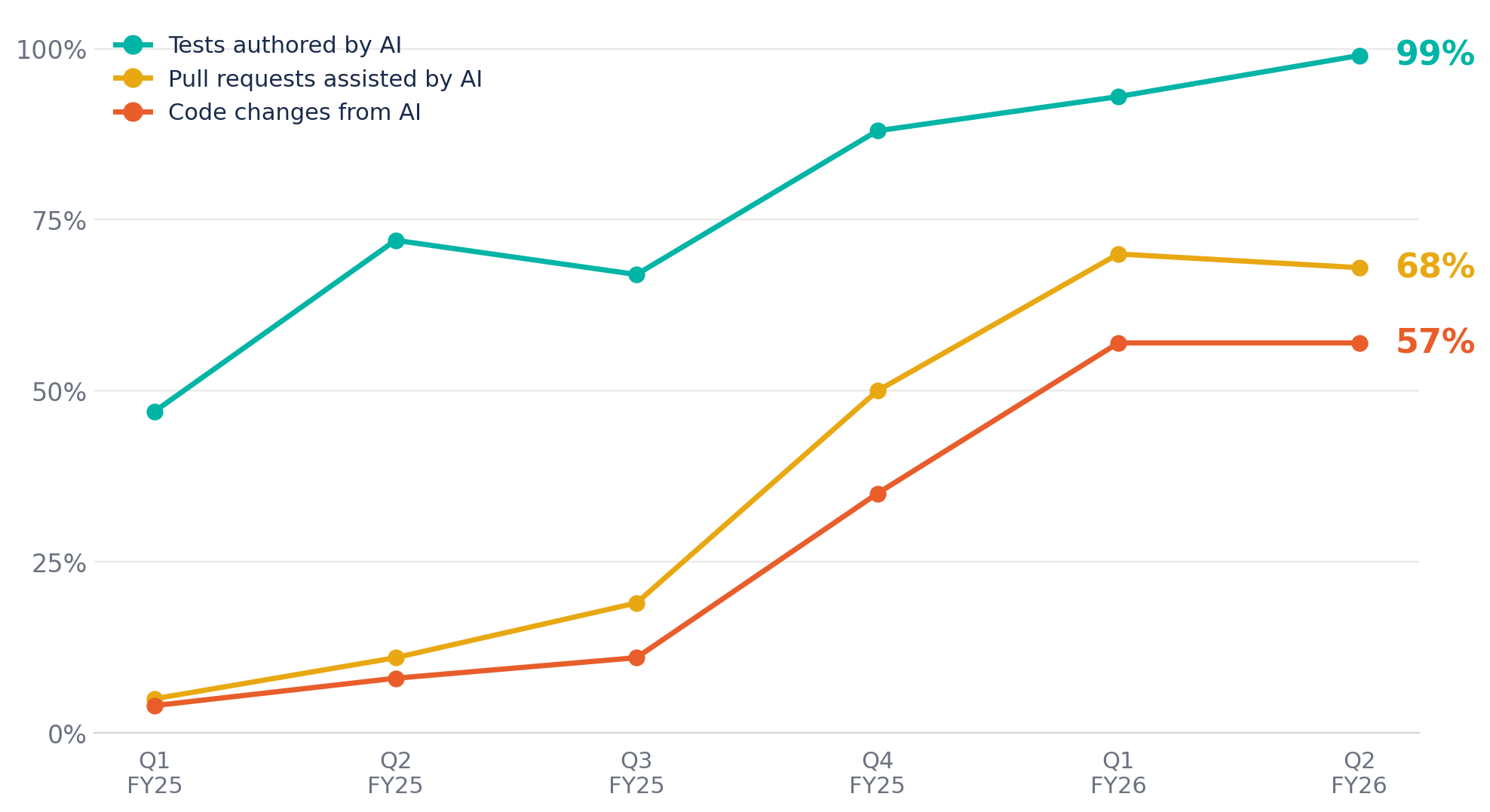
A year ago, AI touched a rounding error of the work. In Q1 FY2025, roughly 3% of pull requests carried any AI assistance, and AI accounted for under 10% of the code changed. By Q2 FY2026, those figures had crossed over decisively. AI now assists close to seven in 10 pull requests and contributes more than half of all code changed. Test authorship moved even faster, with QualityMate writing the large majority of new tests by the end of the period.
None of this happened on its own. It took a sustained, deliberate push. We put modern coding agents in the hands of every team, set clear guardrails for review and security so people could trust the output, and made the AI-assisted path the default way work gets done. As part of that bold goal, we required every person in engineering to use AI, which has driven adoption to 100% across the team. We measured adoption team by team, cleared the friction that slowed it, and reinvested the hours it freed into harder problems. We also built our own agents, the Mates, to carry the work through every stage of the lifecycle, which the next section covers in full. The shift below is the product of that work.
The shape of the curve matters as much as the endpoints. Adoption held at low levels through the first half of the year while tooling, guardrails, and developer trust were established, then accelerated sharply once the foundations were in place. The crossover quarter was Q4 FY2025, when AI assistance on pull requests jumped from under 20% to about half. That is what adoption looks like when people have to trust a tool before they rely on it. Once the trust was there, it stuck.
Engineering teams are seeing velocity improvements of 3X to 8X+.
Per-team velocity gains over the period.
It is worth being precise about what assistance means here. These figures count only pull requests and code where AI materially contributed to the change. The practical effect is that the median engineering task now begins with an AI-generated draft that a human reviews, refines, and owns. The role of the engineer has shifted toward direction, review, and judgment, which is where senior engineering time carries the most value. The sections that follow show how we built the system that makes this the default, and what it produced.
In Part 2, I'll walk through the Mates program in detail: the purpose-built agents that carry work across every stage of the lifecycle, and the orchestration layer that holds them together. That system is what turned this adoption curve into a step change in how we ship.


