How to Defend Your 2027 Legal Technology Budget to the CFO

TL;DR
Budget increases have not closed the resourcing gap: 47% of general counsel (GC) report insufficiently resourced departments despite budget increases, according to the Axiom 2025 GC Survey Report. A 2027 legal technology budget therefore needs a funding order and a script for the chief financial officer (CFO). Fund capacity first, visibility second, and governance third.
A 2027 legal technology budget request invites one question from the CFO: what did the last investment deliver?
For many legal departments, the answer is a pilot that has not yet scaled.
The BCG 2026 Legal Industry Survey found that 91% of corporate legal departments are piloting AI tools, yet the majority have not begun delivering value at scale.
So, closing that gap begins with planning the technology budget.
How Should a Legal Department Plan Its 2027 Technology Budget?
A legal department should fund in this order, in 2027:
- Capacity first, with tools that keep high-volume work in-house
- Visibility second, so it can see matters, spend, and workload
- Governance third, so output is defensible
Judge every line by three tests: does it move the business faster, keep more work in-house, and hold up to scrutiny? Meeting those tests is essential because rising costs and new needs are all pulling from the same flat budget, making 2027 planning harder than in previous years.
Why Is Legal Budgeting Harder Going Into 2027?
Three pressures now converge on the 2027 legal department budget, and each carries its own number.
- First, resourcing, as per the Axiom 2025 GC Survey Report, covering 500 GCs across the US, EMEA, and APAC, found that 47% say their departments remain insufficiently resourced despite budget increases
- Second, outside counsel costs. Law firm worked rates rose 7.4% in 2025 against 2.8% inflation, according to the Thomson Reuters Institute (TRI) Law Firm Rates Report 2026. Each matter that leaves for lack of internal capacity therefore meets higher rates
- Third, AI value. The BCG 2026 Legal Industry Survey found that 91% of corporate legal departments are piloting AI tools, yet the vast majority have not begun delivering value at scale
Legal must consequently expand in-house legal capacity, control spend, and show AI value in one budget cycle. And that pressure is where most budget requests run into trouble.
Why Do Legal Budgets Stall Between Capacity and Trust?
Requests stall where two traps meet: one drains money, and the other accumulates risk.
- The Capacity Trap forms when demand grows, headcount stays flat, and overflow work leaves at premium outside counsel rates
- The Trust Gap forms where outputs go unverified, tools sit ungoverned, and quality becomes hard to defend. In a Litera survey of Fortune 1000 legal leaders, 75% cite data privacy and security as their top AI-related risk
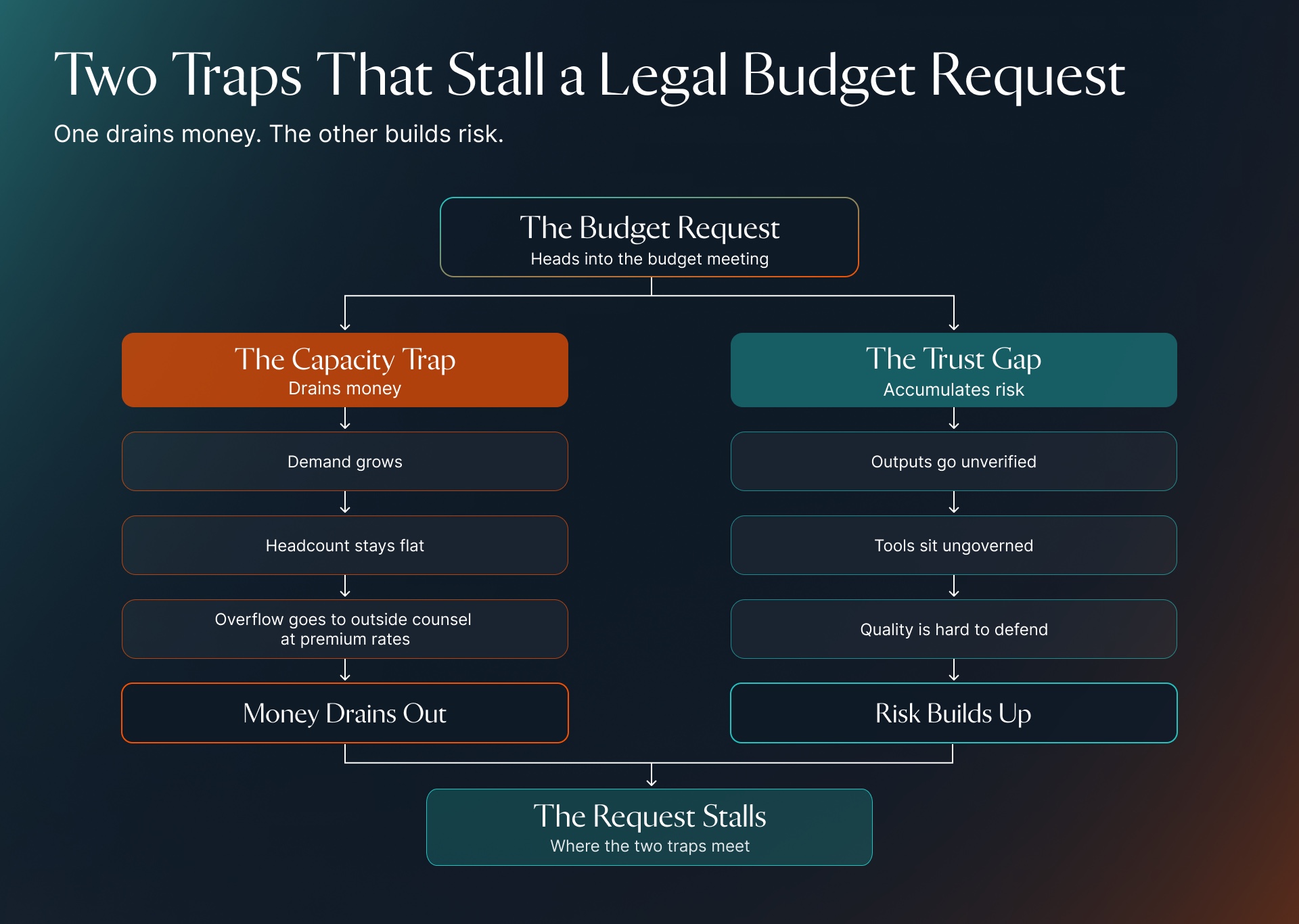
How the Capacity Trap, which drains money, and the Trust Gap, which accumulates risk, both stall a legal budget request
In the budget meeting, both traps turn into two direct questions: where is money leaking out, and where is risk building up? Built on over 30 years of legal expertise, Litera addresses both by unifying the practice and business of law on a single AI platform trusted by 74% of the Fortune 100.
The money question has the more direct fix, so capacity leads.
What Should Legal Fund First to Create Capacity?
Capacity comes first because high-volume work returns time fastest, and keeping that work in-house keeps it out of premium outside counsel rates.
Legal leaders already expect AI to reach this work. Even BCG found that 74% of corporate legal respondents expect AI to most affect contract drafting and negotiations, 72% contract lifecycle management, and 63% corporate governance and compliance.
Those expectations convert to capacity only when AI works where lawyers already work.
Lito, Litera's award-winning Legal AI agent, runs in Word, Outlook, Google Workspace, and the web, so adoption needs no new habit. Where accuracy is non-negotiable, rules-based engines built over 30 years carry the load: Kira reports 95%+ precision on target provisions, and the Negotiate capability delivers deterministic redlines that Litera states are more accurate than general-purpose large language models.
What to tell the CFO? This spend moves work out of premium outside counsel rates and back in-house, as a Litera guide on reviewing more contracts without more outside counsel explains.
Capacity alone, however, gives the CFO a claim without a ledger, so visibility follows.
Why Does Visibility Come Second?
Visibility comes second because an ask earns credibility only when legal can show the work behind it.
A GC needs to see workload by matter, spend against budget, and cycle times, since a number legal cannot see is a number legal cannot defend.
That visibility directly affects what you pay outside counsel.
A second TRI finding shows that while law firms raised their standard worked rates by 7.4% in 2025, the effective rates actually paid by companies over $10 billion in revenue dropped by double digits.
In our view, which TRI does not state, teams that can see and benchmark spend are better placed to capture that gap.
Litera Matter Management serves as the system of record for the work itself. It connects tasks, approvals, and signatures in one workflow and gives real-time visibility from kickoff to close.
What to tell the CFO? here is what legal is working on, and what it costs, by matter.
However, seeing the work still leaves one question open: can legal defend what that work produces?
Why Does Governance Come Third, and What Does It Protect?
Governance comes third because it protects the first two investments: capacity gains carry no weight with the CFO if output cannot be defended.
BCG found that 40% of corporate legal respondents cite trust in AI accuracy as a top-three barrier, and 49% cite workflow integration.
Accordingly, controls belong in the budget from the start.
GenAI can be switched off entirely while the rules-based engines keep working, and the Litera Trust Center lists ISO/IEC 42001:2023, the AI management system standard.
The legal exposure is concrete.
On Feb. 10, 2026, in United States v. Heppner (S.D.N.Y.), the court held that documents created with a public AI tool were not privileged, and Litera recommends a two-tier setup: approved enterprise platforms for confidential work, and consumer tools kept away from privileged material.
What to tell the CFO? The savings are real because the output can be defended.
With three investments funded, one question remains: what should legal stop paying for?
What Should Legal Not Fund in 2027?
Legal should fund one tool per problem, because fragmented tools, inboxes, and playbooks create risk and reduce visibility.
Fixing the foundation comes first. BCG found that 47% of corporate legal departments cite data readiness as a top barrier to AI adoption, a separate finding from the Axiom 47% above. Before any renewal, ask three questions:
- Which tools overlap?
- Which hold data nobody else can see?
- Which can run inside Word and Outlook?
Honest answers release budget, and the final task is to present the ask in words finance will repeat.
How Can Legal Defend Its 2027 Budget Ask to the CFO?
A defensible ask combines the three "What to tell the CFO" lines into one script, which answers how to justify legal technology spend to the CFO:
- Capacity: this spend keeps work in-house and avoids premium outside counsel rates
- Visibility: here is what legal is working on, and what it costs, by matter
- Governance: the savings are real because the output can be defended
Finance will also ask about legal AI ROI, and hours saved cannot answer it alone. Litera frames Return on AI (RoAI) for in-house legal around three measures: speed to the business, work kept in-house, and defensibility of output.
What Belongs on Your 2027 Legal Technology Budget Checklist?
Eight questions turn that script into preparation and form a legal budget checklist the CFO can audit:
- Which work went to outside counsel last year that could have stayed in-house?
- Can I see workload and spend by matter today?
- Where are my pilots, and which have shown value at scale?
- Which tools overlap, and which could be consolidated?
- Is my contract data ready for AI to use?
- Can I defend every AI output to the business, a regulator, or the board?
- How will I report return beyond hours saved?
- What would I stop funding if the budget stayed flat?
Start with the question that stung.
You may find one or two of those eight questions harder to answer than the rest. We can help you work out where to begin. Let's talk.
Frequently Asked Questions
How do you justify legal technology spend to the CFO?
Tie every line to a result the CFO already tracks. Capacity spend keeps high-volume work in-house and avoids premium outside counsel rates. Visibility spend shows workload and spend by matter. Governance spend makes the savings real, because the output can be defended.
What should general counsel fund first on a flat budget?
Fund capacity first. Contract review, first drafts, and document comparison return time fastest, especially when AI works inside Word and Outlook. BCG found 74% of corporate legal respondents expect AI to most affect contract drafting and negotiations.
How do rising outside counsel rates affect the legal budget?
Law firm worked rates rose 7.4% in 2025 against 2.8% inflation, according to the TRI Law Firm Rates Report 2026. TRI also reports that effective paid rates for corporate clients above $10 billion in revenue fell at a double-digit rate in 2025.
Why do so many legal AI pilots fail to deliver value?
BCG found that 91% of corporate legal departments are piloting AI tools, yet the vast majority have not begun delivering value at scale. Its named barriers include workflow integration (49%), data readiness (47%), and trust in AI accuracy (40%).
How can legal departments reduce technology sprawl?
Before renewing any tool, ask which tools overlap, which hold data nobody else can see, and which can run inside Word and Outlook. Fragmented tools, inboxes, and playbooks create risk and reduce visibility. Fix data readiness first, then add tools.


