Due Diligence Is Where Law Firm Margins Disappear

TL;DR
- Due diligence is expensive because document volume, repeated review and scope that moves after kickoff add hours the fee rarely covers.
- On fixed or capped fees, those hours come out of margin. On hourly matters, clients refuse to pay for them.
- Faster review protects margin only when lawyers can trust the output.
- Measure rework, not just hours saved, and insist on findings that link to their source.
A new batch of amendments lands mid-review, with nothing marked which agreements they change. Now without clear map of what changed, an associate must reread a contract already cleared days earlier, spending an unplanned hour manually hunting for edits, and still hoping nothing slipped through
Multiply that hour across every amendment, every practice group, every deal in flight, and the fee the firm quoted stops covering the work. That is due diligence; the place where margins disappear, one unplanned hour at a time.
Why Is Due Diligence So Expensive for Law Firms?
The cost of due diligence doesn’t come from one place. It compounds: more documents to review, multiple specialist teams examining the same matter from different angles, and a scope that continues to shift as the deal progresses.
Then the fee model determines whether the firm or the client absorbs those additional hours.
Volume alone can be significant. Virtual data rooms that once contained a few thousand documents now routinely contain 50,000 or more, and junior lawyers often spend an hour per document on the first read.
And, that first read is rarely the only one.
Corporate, employment, IP and privacy practice groups each go through the same data room, then reconcile their findings into one risk picture.
Even then, the document set does not stay still. Amendments arrive mid-review, often with no indication of which agreement they change, so finished work is reopened.
Someone has to pay for these hours, and alternative fee arrangements have shifted that burden directly onto the firm.
90% of firms with 50+ lawyers now offer them, which turns due diligence costs for law firms into a margin problem:
- On capped fee due diligence, every overrun comes out of the firm's margin. If the data room doubles, the fee does not.
- On hourly matters, the client pushes back instead. As one in-house counsel on Litera's Customer Advisory Board put it: "We won't pay for the time it takes to do due diligence. We won't pay for tasks that are now done quickly with AI."
Either way, the firm absorbs hours it never planned for.
Where Do Time, Effort, and Profit Disappear in the Diligence Process?
Those hours disappear at five points in the legal due diligence process.
Generally, reviews move through 6 stages: staffing the review, opening the data room, triage, review, requesting more information, and the client deliverable.
The first three set the work up. The last three are where margin leaks.
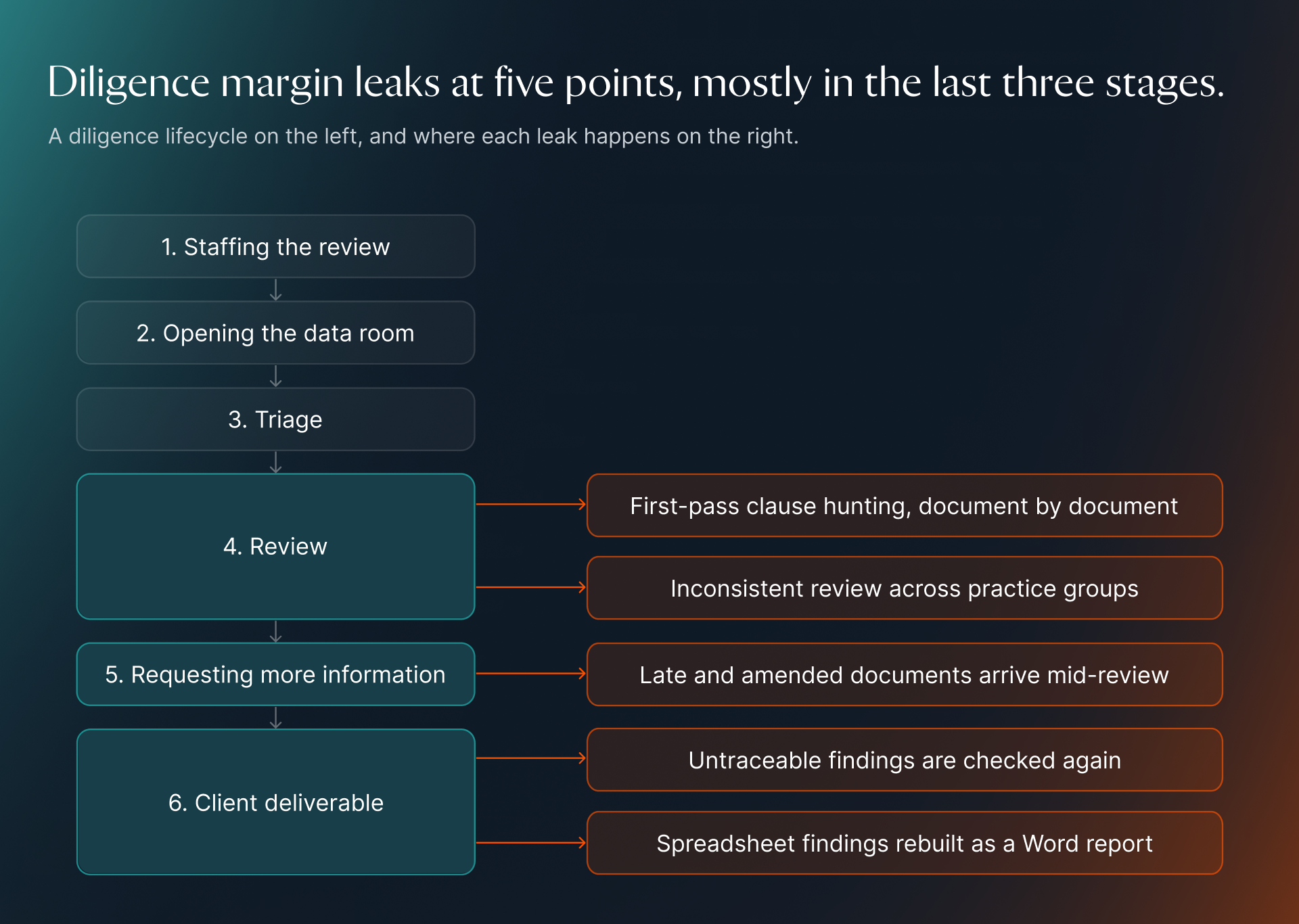
- First-pass clause hunting (review): Reading every document for standard provisions is where the hour per document goes.
- Inconsistent review (review): Each practice group records findings its own way, so someone normalizes them before risks can be compared.
- Late and amended documents (requesting more information): Each new round is matched against what was already reviewed.
- Untraceable findings (client deliverables): A finding with no link to its clause is checked again before sign-off.
- The spreadsheet to Word handoff (client deliverables): Findings are rebuilt by hand as a client report.
All five leaks share one cause: work done twice. That makes due diligence rework a better measure than hours saved, and it explains why AI has not solved the problem on its own. 67% of legal professionals worry that the cost of verifying AI output outweighs its efficiency benefits.
Why Doesn't Faster Review Automatically Protect Margin?
Faster review protects margin only when lawyers can trust what it produces.
If they cannot, the hours saved on the first read come back as rework, and the leak simply moves downstream. And this is the Trust Gap everyone wants to get rid off.
Also, the risky failure is rarely an obvious error. It is an answer that looks right but is not fully supported by the documents, so a lawyer still has to prove it anyway, and the margin leak returns. No wonder 63% of firms rank accuracy among their three biggest generative AI concerns.
However, the Trust Gap is not the only way speed fails to pay off. On hourly matters, faster review means fewer billable hours, so unless the firm reinvests the time it frees up, going faster can mean billing less for the same deal. Understand that, efficiency without trust, and without a plan to reinvest it, can leave a firm worse off either way.
To protect margin across both fixed-fee and hourly deals, speed has to be paired with verifiable accuracy and a way to turn reclaimed hours into new capacity. In practice, true return on AI in due diligence comes down to three outcomes:
- Efficiency that sticks: Time saved on initial review is not erased by downstream verification and rework.
- Defensible client advice: Every finding traces cleanly back to the source language, deepening client confidence.
- Scalable deal capacity: Reclaimed associate hours create bandwidth for more transactions and more predictable pricing on alternative fee arrangements.
General-purpose speed tools address only the first point, and often temporarily. Delivering all three requires technology engineered specifically for the rigor of legal practice.
How Does AI Change the Economics of Due Diligence?
Can AI do legal due diligence? Yes, but the economics only change when the AI is matched to the work: deterministic, lawyer-trained extraction where precision must be proven, and generative AI where breadth helps. That principle runs through Litera's Legal AI platform. In diligence, it takes the form of contract intelligence: structured, source-backed answers extracted from contracts.
Litera Kira brings contract intelligence to due diligence. In AI contract review for M&A due diligence, it moves three levers that answer the costs above:
- The cost of the first read: Lawyers start from a grid of extracted findings instead of reading every document.
- Predictability of scope and price: New document rounds are handled mid-review, and amendments are linked to their originals.
- Capacity per matter: Every practice group works in one shared matter, and cross-document questions are answered with one-click citations.
This rests on Litera's 30 years of legal expertise. Kira's 1,400 contract review fields were trained on 45,000 lawyer hours across 50 jurisdictions, and roughly 60% of the Am Law 100 use Kira.
What Makes AI-Assisted Diligence Defensible to a Partner and a Client?
Speed only protects margin if a partner will sign off on the result and a client will rely on it. That is the real test of AI accuracy in legal document review, and it is where generic tools risk AI hallucinations that read as confident but are not supported by the documents. But, Kira's answer comes down to four tests:
| Test | What it looks like in Kira |
|---|---|
| Source | Every answer carries a source citation from Kira's legal AI, one click from its clause, so lawyers verify less. |
| Consistency | Lawyer-trained fields extract provisions the same way for every practice group, so findings roll up without manual reconciliation. |
| Control | That is AI governance for a law firm in practice: generative AI can be switched off for any project where a client does not permit it. |
Together, the tests keep lawyers in control of every call on materiality and risk. Firms that use Kira describe the result in terms of quality, not just speed:
What Happens After the Review Is Done?
A defensible review still has to become a report the client can act on. That is the fifth leak point: the handoff from spreadsheet to Word.
Lito, Litera's award-winning Legal AI agent, helps close it by drafting a first due diligence findings report, a red flags report, from a Kira Grid export. The draft flags items such as consents, termination rights and inherited liabilities, and the lawyer refines it against the source contracts. Also, Lito is included with Kira subscriptions.
How Can Practice Leaders Protect Diligence Margin Without Cutting Corners?
Tools help, but margin is protected first by knowing your own numbers. Five questions map to the leaks above:
- Where do hours go by stage? Without that split, no one sees which stage eats the fee.
- What is the rework rate, and why? Track how often findings are re-checked before sign-off.
- How often does scope change after kickoff? Due diligence scope creep is where fixed fees break.
- Can every finding be traced to its source? If not, the review gets done twice.
Clear answers to these five questions do not require cutting corners, they simply make it visible where rework is happening, and where margin can be recovered.
Frequently Asked Questions (FAQs)
Why is due diligence so expensive for law firms?
Due diligence costs for law firms rise with document volume, repeated review across practice groups, and scope that changes after kickoff. Junior lawyers often spend an hour per document. On fixed or capped fees, every overrun comes out of the firm's margin.
How much does legal due diligence cost?
There is no fixed price. Legal due diligence cost scales with document volume, how many practice groups review the same data room, and how often scope changes after kickoff. On a fixed or capped fee, every hour beyond the original estimate comes out of the firm's margin, not the client's invoice.
How can a law firm make fixed-fee due diligence profitable?
Measure where hours go by stage, how often findings are reworked, and how often scope changes after kickoff. Then price from your own deal history. Review tools that link every finding to its source remove the second review that erodes fixed-fee margin.
Can AI do legal due diligence?
Yes, when it is matched to the work. Lawyer-trained extraction handles the first read and flags provisions a human would otherwise hunt for by hand. Lawyers still decide what is material, which version of a document governs, and what goes into the client report.
Does AI actually reduce due diligence costs?
AI reduces due diligence costs only when lawyers can trust its output. If every answer has to be re-checked, the hours saved in review return as rework. Rework rate is the better measure, because it shows whether the efficiency was real.
How do you measure ROI from legal AI?
Litera measures Return on AI (RoAI) across three kinds of growth: efficiency growth from hours saved, relationship growth from work clients trust, and business growth from capacity returned. Speed alone captures only the first, and only when hours are not lost to rework.
Is AI contract review reliable enough for M&A due diligence?
Yes, when the review passes four tests: every finding links to its source, the whole set is covered, reviewers work to one standard, and the firm controls when generative AI is used. Lawyers then spend their time on materiality and risk, not re-checking extractions.


