The Mates Program: One Orchestrated Pipeline

Part 2: The Mates Program
R&D performance, Q1 FY2025 through Q2 FY2026
By Greg Ingino, Chief Technology Officer, Litera
This is Part 2 of a three-part series on how Litera transformed its R&D organization over the last 18 months. Part 1 covered the adoption arc and the headline business outcomes. Here, I'll go deeper on the Mates, the system of purpose-built agents that moved AI from a developer tool to the backbone of how we ship software.
02 The Mates Program: One Orchestrated Pipeline
The numbers in this report come from a deliberate program. We built a system of purpose-built agents, the Mates, with each one owning a stage of the lifecycle, and we orchestrate them end to end through ARGO, our centralized agent orchestration platform. A single layer dispatches each phase and hands work from one stage to the next, so the whole lifecycle runs as one connected system rather than a set of disconnected tools.
The pipeline carries a feature from idea to market. Discovery and definition sit on the product side, the R&D phases run from build through run, and go-to-market is automated as its own first-class phase. Every stage has a named owner, and every agent is grounded in our living, centralized Knowledge Repository, which is built, fueled, and tested hand in hand with the Litera Platform team. As the build-through-run phases have accelerated, go-to-market has become the part of the lifecycle that most needs the same treatment, and where much of our current attention sits.
| Stage | Phase | Owning Agent |
|---|---|---|
| Product | Discover | POMate |
| Product | Define | ScrumMate |
| R&D | Build | DevMate |
| R&D | Test | QualityMate |
| R&D | Secure | SecureMate |
| R&D | Deploy | OpsMate |
| R&D | Run | SREMate |
| Product | Go-to-Market | GTM |
The AI-driven lifecycle, idea to market, from Discover through Go-to-Market. Product phases bookend the R&D phases.
The design goal is to remove as many human touchpoints as possible to deliver an entire feature, then automate the sign-offs that remain. It was equally about removing handoffs: in the old model a single dev team passed work through at least four of them, and a team can now run a feature end to end with none. Confidence-scored review agents now stand in for the PRD, pull-request, and deploy sign-offs, and any low-scoring work routes straight back to the right human reviewer. The best way to see the program's reach is to look at every Mate in production at once.
| Agent | Metric | What it measures |
|---|---|---|
| POMate | 4 hours | Lito PRD to PR, was 15 days |
| ScrumMate | ↓ 89% | Pre-release regression bugs |
| DevMate | 68% | Pull requests assisted by AI |
| QualityMate | 99% | Tests authored by AI |
| SecureMate | ↓ 76% | Vulnerability density |
| OpsMate | ↓ 54% | Build time, 35 to 15.9 hrs |
| SREMate | 47% | Of engineering tickets triaged |
| IT Mate | 40% | IT tickets resolved by AI |
Each Mate in production, headline metric, Q2 FY2026.
We engineered the handoffs out of the model. A single dev team once carried at least four of them, and a self-contained team now runs a feature end to end with none.
POMate: From Idea to a Ready Specification
POMate sits at the very front of the pipeline, across Discover and Define, where a product idea becomes a development-ready specification. It automates the path from a raw idea to a finished PRD and into the first pull request, grounded in the centralized Knowledge Repository and orchestrated through ARGO. The work that used to consume the opening weeks of a feature now happens in an afternoon. At its core is the Grill Me skill, which interrogates a raw idea the way a demanding stakeholder would, pressing with pointed questions until the gaps are closed and the inputs are complete enough to generate a rigorous PRD.
4 hours — PRD to PR for localization in Lito, down from about 15 days. The journey from a defined PRD to a working pull request for localization in Lito has collapsed from roughly fifteen days to about four hours, a step change in how quickly an idea reaches code. This is early proof of what automating the front of the lifecycle delivers.
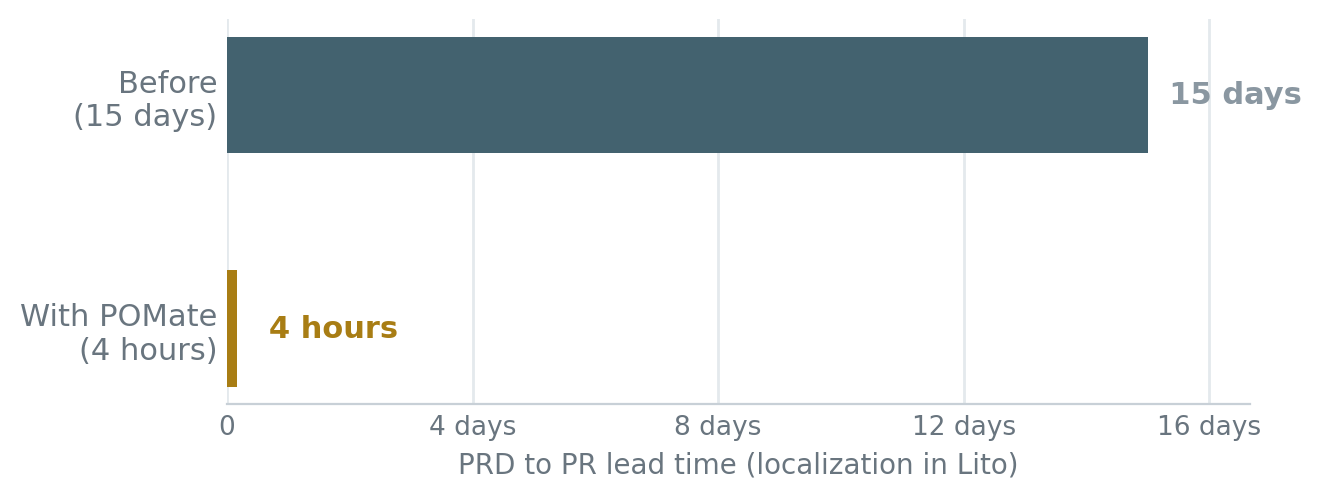
POMate shows that the front of the lifecycle can be automated as effectively as the code itself. The Grill Me skill, the PRD generation skills for the Product Spec, Tech Spec, and QE Spec, and a Requirements Readiness pipeline now run end to end, all grounded in the centralized Knowledge Repository, so a specification holds together from the first question through to the pull request. A confidence-scored PRD sign-off agent, built in ARGO, keeps a person on the decisions that matter while routine approvals move on their own.
The effect on how work begins has been profound. Features that once took weeks to specify now reach a development-ready specification in an afternoon, and the first wave of features is already moving through the new pipeline. The frontier from here is extending the same discipline deeper into Define and Build, so the speed we have unlocked at the very front of the lifecycle carries all the way through it.
The Agents, and What Each One Drives
Each Mate is built for one job and measured on one outcome. The cards below pair each agent with the metric it moved over the period. Read together, they show automation spread across the lifecycle, with a different agent owning each stage.
- DevMate — 68% (Build, code generation): Generates and assists the majority of code. Powered by Cursor and Devin, it now assists 68% of pull requests and contributes 57% of all code changed. Devin-assisted pull requests rose from 77 to over 1,800 in a year.
- QualityMate — 99% (Test, test automation): QualityMate automates about 85% of our tests, a scale that was impossible a year ago. The share of new tests it authors climbed from 47% to 99%, with more than 39,000 AI-developed tests in the suite.
- SecureMate — ↓76% (Secure, vulnerability management): Detects and helps remediate vulnerabilities. Vulnerability density fell 76% over the period, the single largest improvement in our security posture.
- OpsMate — ↓54% (Deploy, DevOps): Handles release and deployment operations. Build times fell from 35 to 15.9 hours, a 54% reduction in the path from commit to deployable. Deployments rose from 82 to over 155 per quarter, while emergency releases remained a small share of that growing volume.
- SREMate — 47% (Run, triage & remediation): Triages tickets coming into engineering: it spots duplicates, flags where more information is needed from the customer, or attempts a remediation and submits a pull request. SREMate handles about 47% of engineering tickets today, with a goal of reaching 100% by the end of the quarter.
- ScrumMate — 100% (Define, sprint readiness): Drives agile and sprint automation. Adoption reached 100% across the Scrum Master team, saving roughly 80 hours of manual effort per sprint and enforcing PDLC readiness gates. Better-structured stories also cut pre-release regression bugs by nearly 90% on the teams that adopted it earliest.
IT Mate now resolves about 40% of internal IT tickets with no human touch, up sharply from a standing start a year ago.
IT Mate share of tickets resolved by AI, Q2 FY2026.
The agents share context and hand work between one another, so a change shaped by POMate, planned with ScrumMate, written with DevMate, tested by QualityMate, and cleared by SecureMate moves through a single connected pipeline. That coordination, more than any individual agent, is what turned isolated time savings into a step change across the whole organization.
The Engine: Tools and Scale
Two coding agents do most of the heavy lifting inside DevMate. Cursor carries the bulk of AI-assisted code, with Devin adding autonomous, longer-running work. Together they took AI-assisted code from roughly a tenth of a million lines per quarter to nearly 3 million, and the split shows a healthy mix of interactive assistance and autonomous execution. We chose these two deliberately and committed, going deep enough to build real fluency, even as newer tools and models kept appearing.
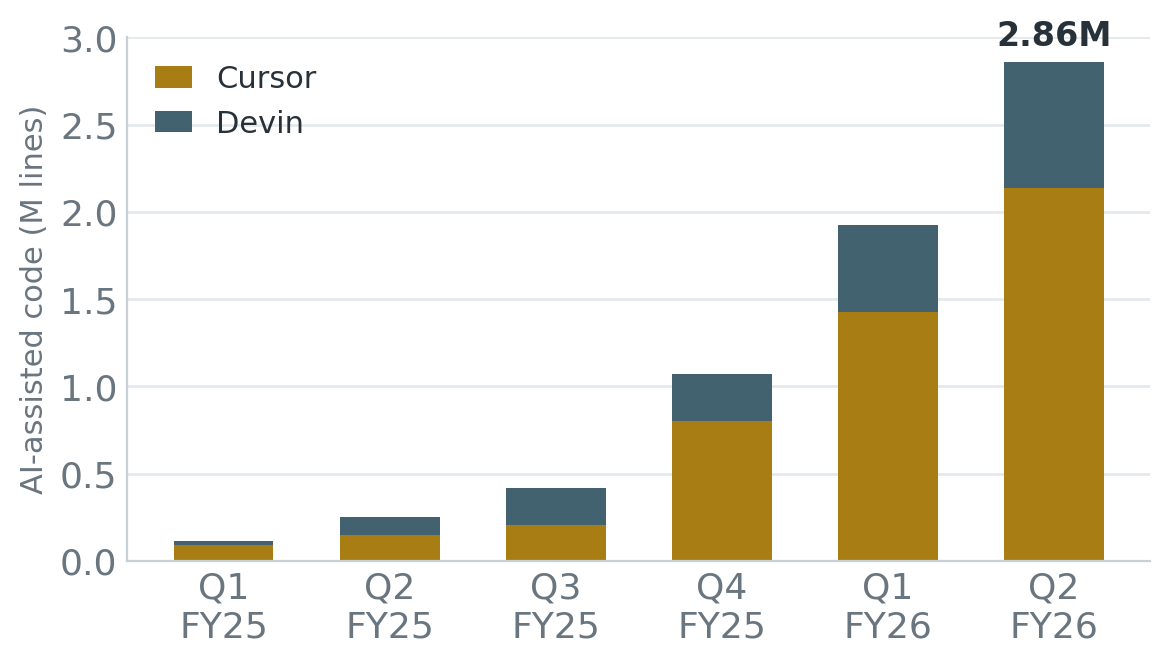
The scale also shows up in raw output. Total code changed across the organization grew from about 2.25 million lines a quarter to about 5 million, with the AI-assisted share rising from a small fraction to the majority, about 57% today. The engine is the combination of these agents working inside a lifecycle built to use them.
We committed to two coding agents and built deep fluency with them, even as newer tools and models kept arriving.
That focus is what turned adoption into scale.
In Part 3, I'll show what it produced: the per-engineer output data, the quality and security results, and the operating leverage that has come with it. I'll also share an honest look at what we're still watching and the principles I'd apply if I were starting this transformation somewhere else.


