Trusting Legal AI When the Stakes Are High

A redline goes out and misses a changed indemnification clause. A redaction looks clean on screen, but privileged metadata is still in the file. A closing set is built on what everyone believed was the final executed version, and it wasn’t. A diligence finding lands in a client report, and no one can point to the clause it came from. An AI-generated analysis reads beautifully, and no one can prove it is right.
None of these outputs looked wrong. Every one of them would pass a quick read. That is exactly what makes them dangerous.
The question is no longer whether lawyers should use AI. Most firms already do. The harder question is one that partners and clients are now putting to firm leaders: how do you make AI useful without compromising the credibility of the work that carries your name?
The short answer: lawyers can trust AI on high-stakes work when the method matches the task, every output can be traced to its source, and the lawyer makes the final call. Here is the longer answer, drawing on our recent Lexology Masterclass and what legal professionals told us in four live polls.
Why Is “Finished” No Longer the Same as “Verified”?
Generative AI produces work that looks finished faster than any team ever could. That is a real strength, and it is exactly why verification now matters more, not less.
None of the five failures above are new. Wrong versions and leaky redactions existed long before GenAI. What has changed is the volume and speed of polished-looking work. Lawyers now review more output, produced faster, under the same deadline pressure. The risk sits in the gap between how work looks and what can be proven about it.
Put simply: finished is not the same as verified.
Who Is Accountable When AI Contributes to Legal Work?
The lawyer who signs it. Whether AI drafted, summarized, or suggested the work, accountability does not transfer to the tool, and neither does the reputational cost.
Legal professionals agree. Asked who is accountable at their organization when AI contributes to a piece of work, 62% of respondents said the lawyer who signs it. Another 19% said the supervising partner, 9% said the firm as a whole, and 9% said they haven’t defined it yet.
That points to a principle worth holding onto: not every task needs the same level of checking, but every output that leaves the building needs someone who can stand behind it.
Can Lawyers See Where AI Output Comes From?
Often, they can’t. That may be the most revealing finding of all.
Asked whether reviewers can see the source behind each AI-generated finding, only 18% of respondents said always. Almost half (46%) said sometimes, 4% said rarely, and nearly a third (32%) said they weren’t sure.
Put that next to the accountability finding and a tension appears. Most people believe the signing lawyer owns the work. Yet most can’t consistently trace that work back to the clause, page, or version it came from. Accountability is clear. Visibility isn’t.
AI governance and verification are not yet where the profession wants them to be. The goal for the next few years should be to move that answer toward “always.” Until then, the gap is where risk lives.
Where Does AI Risk Rise Across a Legal Matter?
Risk rises as a matter moves toward signing. The cost of a probable answer is low at the start of a matter and high at the end.
Here is how that risk curve looks across a transactional matter:
| Stage | Typical work | If the answer is wrong |
|---|---|---|
| Explore | Issue spotting, research directions | Wasted time, usually caught in normal review |
| Draft | First drafts, summaries, clause options | Rework, or off-standard language drifting into the deal |
| Review and diligence | Extraction, findings, obligations | Wrong advice, a missed risk, or a mispriced deal |
| Negotiate | Redlines and counterparty changes | Accepting a position no one agreed |
| Protect | Redaction, metadata cleaning | Privilege and confidentiality exposure |
| Execute and close | Execution versions, closing sets | The record no longer matches the deal |
Early on, ambiguity is useful. Several plausible answers help a team think. By closing, there is only one right answer, and a fluent guess is a liability.
What Is the Difference Between Deterministic and Probabilistic AI in Legal Work?
Deterministic (rules-based) systems give the same result every time from the same inputs. Probabilistic (generative) systems give the most likely answer, which can vary between runs. Each is built for different work.
Deterministic tools are the kind of logic lawyers have relied on for decades: document comparison, metadata-cleaning policies, and find-and-replace across a set. Their value is consistency and traceability. Generative AI is built for interpretation: synthesis, summaries, first drafts, and spotting patterns across large document sets.
Two myths get in the way of good decisions:
- Deterministic does not mean infallible. A comparison run against the wrong base version will faithfully report the wrong differences, every time. Inputs and configuration still need a human check.
- Probabilistic does not mean inaccurate. Generative AI is often right and very useful. But error is a known property of the method. Stanford researchers found hallucination rates of 17% to 33% when they tested leading legal research AI tools (2025). An error arrives with the same fluency as a correct answer.
The right question is never which logic is better. It is which logic fits the task, at this stage, at this level of risk.
Legal professionals already sense where the line falls. Asked which tasks they would rather run by fixed rules than by AI judgment, 74% chose document comparison. Metadata cleaning (29%), redaction (24%), and closing sets (18%) followed. For most lawyers, detecting every change in a document is not a job for a probable answer.
How Do Law Firms Verify AI Output Without Re-Checking Everything?
By building verification into each step of the workflow, instead of loading it all onto one final review. Review at the end is not a control strategy.
Many AI-assisted workflows follow a pattern most lawyers will recognize. Work moves across disconnected tools. Each handoff loses a little context about where something came from. Everything lands on one senior lawyer, under time pressure, who can’t see the sources. So they re-check everything from scratch, and the time AI was supposed to save quietly disappears. Call it the verification tax.
There is a useful way to think about the fix. Firms have always reviewed the work of junior associates. You wouldn’t take a first-year’s draft at face value, and AI output deserves the same discipline. The difference is volume, so the review must be designed in, not bolted on.
Four practices make the biggest difference:
- Ground the work in defined sources: the data room, the agreed draft, or approved precedent, not whatever a model happens to know
- Link every finding to its source: clause, page, and version, so the next reviewer can click through instead of trusting blindly
- Separate exploration from execution: the tools you use to brainstorm strategy are not the tools you use to build a signing set
- Place checkpoints by materiality: more review where an error costs more, lighter review where it doesn’t
Consider one change-of-control clause in an M&A matter. It is extracted verbatim and linked to its page, validated by the deal team, added to the diligence report, judged material at a partner checkpoint, carried into the purchase agreement, and closed from controlled, executed versions. No one at closing had to re-prove what was established at extraction. In other words, confidence is carried, not re-created.
This is where the business case sits, too. Unverified speed just moves the work downstream to the reviewer. Verified speed gives lawyers time back for the client conversations that deepen relationships and win new work.
What Does a Verifiable AI Workflow Look Like in Practice?
The most useful pattern here is not a product. It is a division of labor: generative AI on top, rules-based execution underneath, and the lawyer making the decision.
This is how Litera approaches the practice of law. We have spent 30 years building legal-specific technology for drafting, review, comparison, document protection, and transactions, and our view is that these stages should work as one connected matter rather than a stack of separate tools. Here is what that pattern looks like in two everyday workflows:
- Redline review: a rules-based comparison in Litera Compare surfaces every change against the agreed version. Lito, Litera’s award-winning Legal AI agent, then recommends whether to accept, reject, or revise each change, with a rationale tied to the client’s playbook and the firm’s precedent. The lawyer decides.
- Due diligence: Litera Kira extracts terms verbatim from the documents. Lito scopes the review and drafts the report. The workflow pauses for partner review before findings feed reps, warranties, or closing conditions.
It is the division of labor many lawyers have wanted for years: help with the volume of work, without having to re-check every part that has to be exactly right.
Or take a scenario every transactional lawyer has lived. Forty-eight hours before signing, a defined term changes and must change identically across the whole closing set. By hand, one missed schedule leaves the set inconsistent at signing. In a connected workflow, the lawyer selects the documents from the Litera Transact checklist, previews every change before it runs, saves each file as a new version, confirms a summary of changes, and cleans metadata before anything leaves the firm. The result is a change the lawyer can prove.
What Are Legal Teams Changing First?
Defining risk levels by task. It is the clear priority.
Asked what they would change first, more than half of respondents chose defining risk levels by task. Adding checkpoints earlier came a distant second.
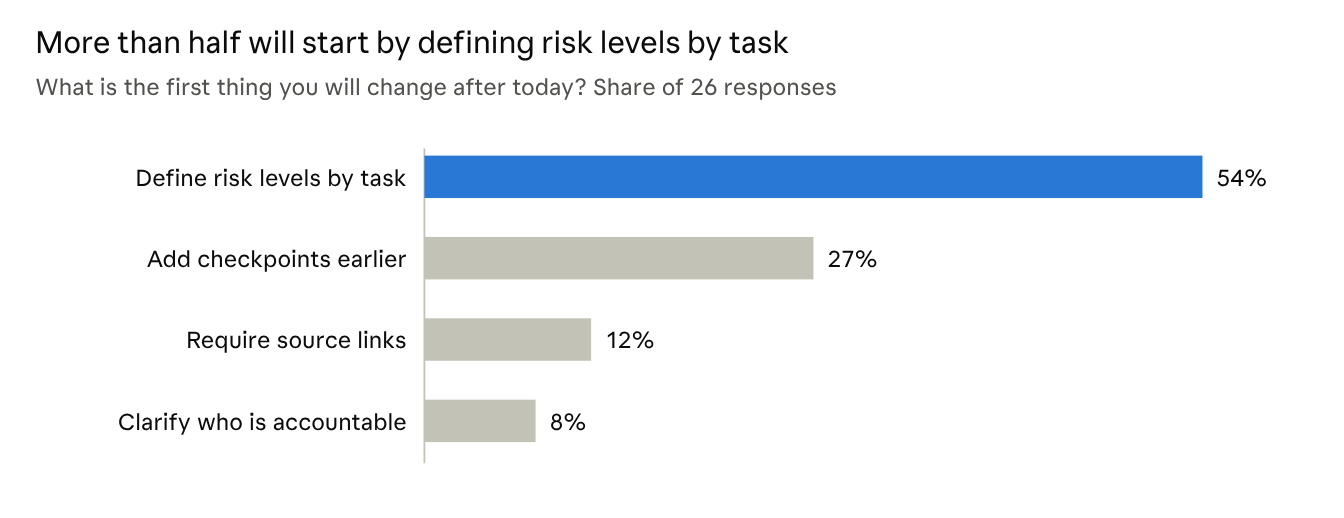
Live poll of Lexology Masterclass attendees, Nov. 2, 2026 · 26 responses, single choice
Think of it this way: you don’t need a Ferrari to drive down the street to the local coffee shop. Not every task needs generative AI. Some low-stakes work is better handled by simple rules, and some high-stakes work should never rest on a probable answer. Matching the method to the task is also a cost decision, because generative AI is not free to run.
The low number for accountability is telling, too. Read alongside the earlier findings, it suggests most teams feel the accountability question is settled. The controls that make accountability workable, such as source links and earlier checkpoints, are still catching up.
How Should a Law Firm Evaluate an AI-Enabled Workflow?
Seven questions help test any AI-enabled workflow, whether you are evaluating a new tool or already using one. If you can answer each clearly, you can defend the workflow to a partner, a client, or a court. If you can’t, that is where to focus first.
- What is the legal task? Specific enough to place it on the risk curve. “We use AI for diligence” is not specific enough.
- What source material should govern the output? A defined set: the data room, the agreed draft, approved precedent.
- What happens if the answer is wrong? Name the consequence, and how close the work sits to a client, a court, or a signature.
- Does the task need probabilistic interpretation, deterministic execution, or both? Each step should use the logic that fits it.
- Can the output be traced and verified? Every finding should link to a clause, a page, and a version.
- Where must the lawyer review or decide? Place checkpoints by materiality, not only at the end.
- Does confidence hold from first input to final delivery? No step should depend on re-creating proof from scratch.
What Should Legal Teams Do Next?
The lesson is not to stop using AI, and it is not to review everything twice. It is to know which work can rest on a probable answer and which work must be proven, at every stage of a matter.
Three questions make a good starting point for any team:
- Where does verification of AI-assisted work happen today: at each step, or only at the end?
- Which workflow lets a probable answer travel furthest before anyone checks it?
- If a client asked how a finding was produced, could you show them?
The goal isn’t to remove judgment from legal work. It’s to make that judgment more informed, more scalable, and more defensible. The firms that earn client trust will be the ones that know the difference between probable and proven.
To go deeper, watch our Lexology Masterclass, “Because Probable Isn’t Proven,” on demand. If you’d like to run the seven questions against one of your own workflows, let’s talk.
Frequently Asked Questions
Can lawyers trust AI on high-stakes legal work?
Yes, when the method fits the task, every output traces to a defined source, and a lawyer reviews at the points where an error costs most. Trust comes from the workflow, not from the tool alone.
What is the difference between deterministic and probabilistic AI?
Deterministic, or rules-based, systems produce the same result from the same inputs every time. Probabilistic, or generative, systems produce the most likely answer, which can vary. Rules suit exact tasks such as comparison and redaction; generative AI suits drafting, summaries, and synthesis.
Who is responsible for AI-generated legal work?
The lawyer who signs it. Whether AI drafted, summarized, or suggested the work, accountability does not transfer to the tool, so every output needs to be verified against authoritative sources.
What is the verification tax?
It is the time lost when a reviewer has to re-check AI-assisted work from scratch because they can’t see its sources. It often erases the time AI was meant to save.
Which legal tasks should run on rules rather than AI judgment?
Tasks that need the same exact result every time: document comparison, metadata cleaning, redaction, bulk changes, and closing sets. In a live poll at our Lexology Masterclass, 74% of respondents named document comparison.
About the Poll
Poll results come from live, voluntary polls of attendees at the Lexology Masterclass “Because Probable Isn’t Proven,” held Nov. 2, 2026. The results are a snapshot of the room, not a survey of the profession.


