The Legal AI Trust Gap: What the 2026 ILTA Survey Reveals

TL;DR
- 94% of firms use or explore GenAI, up from 80% in 2025
- 6% of firms report that AI features in their document management system are enabled and used widely across the firm
- Accuracy is the top concern at 63%, and 58% of firms require human review before AI-assisted work reaches clients or courts
- Closing the gap takes AI accurate enough to need less double-checking, placed inside the tools lawyers already use
Table of Contents
- How Many Law Firms Use Generative AI in 2026?
- Where Is the AI Trust Gap in Law Firms?
- What Are Law Firms' Biggest Concerns About Generative AI?
- Do Law Firms Have AI Policies and Governance?
- What Stands in the Way of Wider AI Adoption?
- What Comes Next: Agentic AI in Law Firms
- What the Trust Gap Means for Law Firm Strategy
- Frequently Asked Questions
A managing partner signs off on client work with the firm's name on every page.
When an AI-assisted draft needs a full second read before it can leave the building, the time AI saved returns as rework, and the partner still carries the risk.
That tension runs through International Legal Technology Association (ILTA) 2026 Technology Survey, which found that 94% of law firms are using or exploring Generative AI (GenAI), up from 80% in 2025.
But trust lags adoption: 63% of firms name accuracy a top concern, and 55% of firms cite product maturity or accuracy as the top barrier to broader use of AI features in their document management system (DMS).
These findings, wide adoption alongside hesitant trust, define the AI trust gap: the distance between how widely a firm adopts AI and how far its lawyers can rely on the output.
ILTA's data covers more than 500 firms, about 50% of eligible member firms, and roughly 140,000 lawyers, which makes it a useful map of where that gap opens. Consequently, the first place to look is adoption itself, and how far it has spread.
How Many Law Firms Use Generative AI in 2026?
Adoption has become close to universal: 94% of law firms use or explore GenAI, up from 80% in 2025.
Such breadth has a recognizable shape, because lawyers adopt AI that lives in the tools they already use.
Microsoft 365 Copilot shows the pattern, leading the tool mix with 76% of the firms using or exploring it, and its position shows how much familiarity matters.
Even so, exploring a tool and relying on it remain different commitments.
The next question is how widely firms use that AI day to day.
Where Is the AI Trust Gap in Law Firms?
The 94% figure describes exploration, and that picture thins quickly once the question moves to routine use.
When asked about AI features in their primary DMS, firms answered as follows:
- 59% have no access
- 15% have access but have not enabled it
- 9% use it only in limited pilots
- 9% use it in one or a few groups
- 6% use it widely across the firm
The 6% answers a different question than the 94%, so the two figures sit side by side without forming a ratio.
These responses invite an obvious follow-up about why firms hold back, and firms supply the reasons themselves.
Product maturity and accuracy concerns lead at 55%, followed by licensing or cost (40%) and confidentiality or security (39%).
These barriers show firms keeping AI features at arm's length until the output earns confidence, and accuracy sits at the center of that hesitation.
If accuracy carries that much weight, how large is the concern, and what has changed around it?
What Are Law Firms' Biggest Concerns About Generative AI?
Accuracy stays the top concern, at 63% in 2026 against 82% in 2025, and confidentiality or misuse follows at 55%, down from 86%.
AI cost and return on investment have also moved up the list, ranking as a top concern for 41% of firms.
As risk concerns ease, the question moving to the front is whether AI pays off, and in the meantime, firms have answered the concerns that remain with rules.
Do Law Firms Have AI Policies and Governance?
Such rules are widespread, and they show how firms manage accuracy today.
While 78% of firms now have a formal AI policy, those policies still lean heavily on lawyers acting as the final reviewer:
- 59% allow only vetted, firm-approved tools
- 58% require human review before work reaches clients or courts
- 40% require independent verification with citations to authoritative sources
In other words, current AI governance in law firms treats lawyers as the ultimate quality control layer, and that reliance on manual review keeps accuracy at the center of the conversation.
Accuracy that does not need double-checking is therefore the logical next step, and it depends on matching the AI to the work, since deterministic AI verifies every change while probabilistic AI predicts what probably changed.
Even so, well-built governance and accurate tools deliver value only when lawyers choose to use them, which turns the focus to what keeps them from doing so.
What Stands in the Way of Wider AI Adoption?
The lawyers' own habits and concerns supply much of the answer:
- Resistance to change among users and security or risk tie at 50%, with resistance down from 57% and security or risk down from 54%
- Beyond those two, lack of user skills follows at 45%, not enough time for timekeepers to learn at 40%, and no clear demonstration of value at 25%
Each of these barriers grows when a tool asks lawyers to change how they work, which is why AI embedded where lawyers already work removes a share of them, because the lawyer opens the same document and finds the assistance there.
An analysis of embedded AI in legal teams reports that refocusing after a context switch takes an average of 23 minutes, which shows what each extra tool can cost. Those costs will matter more as AI begins to act on its own.
What Comes Next: Agentic AI in Law Firms
That shift is already under way.
Among firms already experimenting with, testing, or using agentic AI, business support functions lead at 73%, followed by internal automation and workflows at 66%, the practice of law at 48%, knowledge management and research support at 47%, and client-facing tools at 10%.
As agentic AI moves toward the practice of law, the stakes on accuracy rise, and by extension the trust gap matters more.
What the Trust Gap Means for Law Firm Strategy
That strategic question centers on cost and ROI, the concern 41% of firms now name, and efficiency alone does not answer it.
When AI compresses legal work, billable hours contract unless the time saved becomes deeper client relationships and new business.
The shift is already visible: UK Top 100 firms now estimate that AI could ultimately save around 18% of chargeable hours, up from 16% a year earlier, according to PwC's 2026 Law Firm Survey.
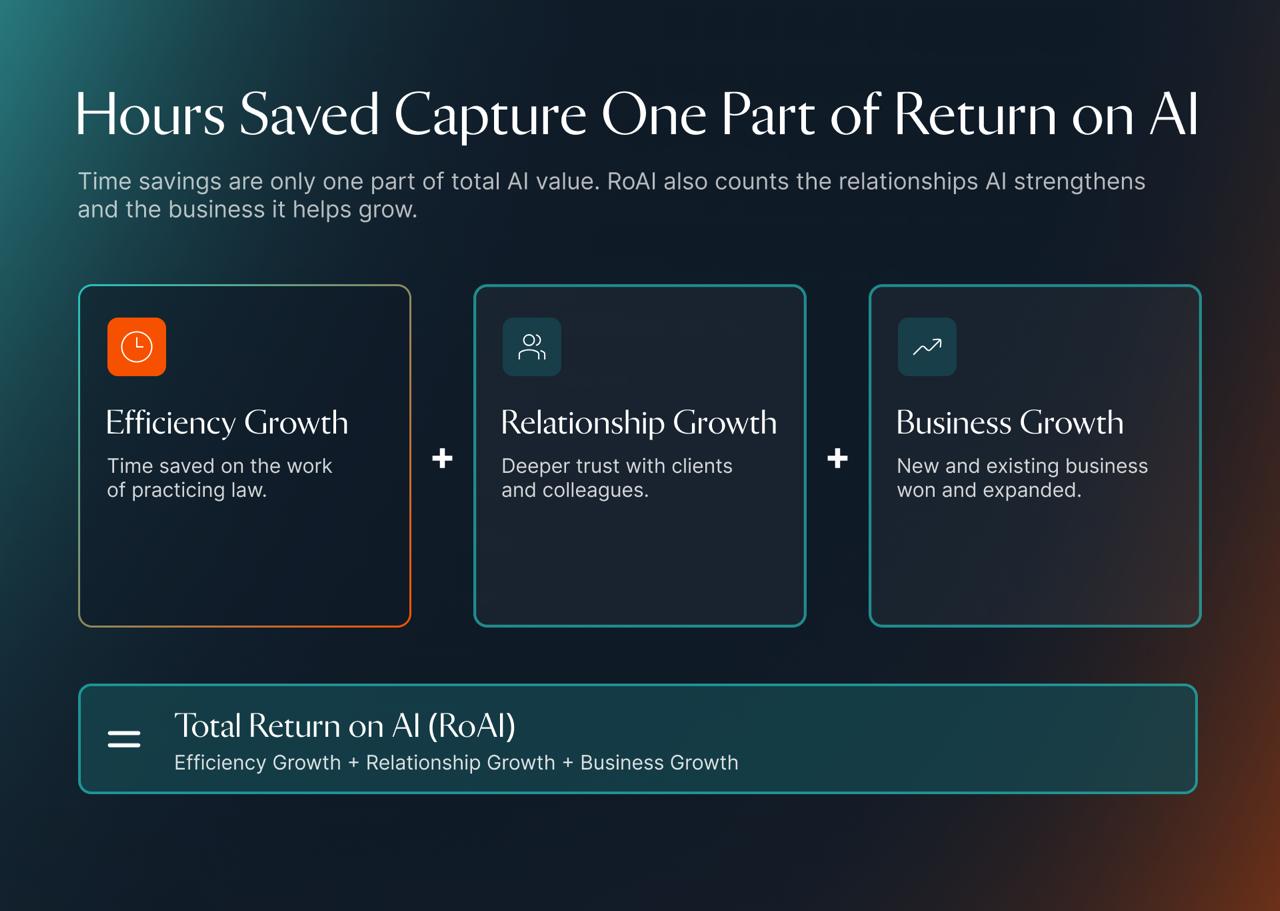
Return on AI (RoAI) captures all three: Efficiency Growth, Relationship Growth, and Business Growth. Delivering all three calls for depth in both the practice and the business of law.
Litera is trusted Legal AI that unifies the practice and business of law, built on 30 years of legal expertise no AI startup can shortcut.
Such a foundation matters because platforms built only for efficiency solve half the problem, and AI-first entrants can look compelling in demos and then underdeliver in deployment.
Litera applies deterministic engines where precision must be proven and generative AI where speed helps, and that approach leads to three outcomes for firms closing the gap:
- The first outcome is accuracy a lawyer can stake judgment on, supported by deterministic engines refined over 30 years of experience
- The second is AI inside the tools lawyers already use. Litera's award-winning Legal AI agent, Lito, runs inside Word, Outlook, the web, iOS, and desktop, while Litera Compare and Firm AI Search are now available inside Microsoft Copilot and ChatGPT, with no new platforms or behavior change
- The third is firm intelligence that turns reclaimed time into growth, since Firm AI Search returns cited answers from matter history, credentials, and client data while respecting ethical walls, and 35% of firms already use GenAI on their experience data
With the gap mapped and the outcomes defined, firms ready to close it can see how Litera works in the on-demand Speed You Can Defend webinar or explore the platform.
Frequently Asked Questions
What Does the ILTA 2026 Technology Survey Say About AI Adoption in Law Firms?
94% of firms use or explore GenAI, up from 80% in 2025. Just 6% report DMS AI features are enabled and used widely across the firm.
What Are Law Firms' Biggest Concerns About Generative AI?
Accuracy leads at 63%, followed by confidentiality or misuse at 55% and cost & ROI at 41% in 2026.
Do Law Firms Have AI Policies?
78% have a formal policy, and 58% require human review of AI-assisted work before it reaches clients or courts. Another 59% allow only vetted, firm-approved tools.
Who Oversees AI at a Law Firm?
The chief information officer (CIO) or head of technology holds primary responsibility at 36% of firms, followed by a GenAI task force at 18%. Firm administration leads at 12%.
What Is the Biggest Barrier to Wider AI Adoption in Law Firms?
Resistance to change among users and security or risk are tied at 50%. Lack of user skills follows at 45%.
Which AI Tool Do Law Firms Use Most?
Microsoft 365 Copilot, used or explored by 76% of firms using or exploring GenAI. Its reach shows that lawyers adopt AI inside tools they already use.


